
While fictional scenes of danger are being played out in front of the cameras, real life action stars are standing by to keep cast and crew safe from danger. The scale of security on a film or TV production security can vary widely–from a security guard to a security perimeter, from a production assistant placing orange cones to an advance team engaging with foreign governments to arrange emergency services for dozens of crewmembers.
This article launches ¡AU!’s series on the people, companies, and organizations who are working alongside creative teams to guard assets, prevent incidents, and save lives.
Global Protection Shield (GPS) specializes in security and executive protection, particularly on shoots outside of the United States. Based in LA, film and TV production has been a significant part of the company’s business.
Their biggest contract has been providing security for The Amazing Race, CBS’s epic reality show, now approaching its 40thth US season. The show pits teams against each other in an around-the-world dash, featuring multiple international locations and has spawned 14 more incarnations internationally.
Global Production Sheild also helps individual productions in preparation and set-up in global locations, including Africa, the Middle East, and Southeast Asia.
Safety first
Security for these international productions starts well before production begins, first with travel intelligence, where consequential information about locations—from infrastructure to local resources to security threats minor or major—is collected and relayed to production decisionmakers. An essential component of this prep is emergency medical preparedness, a comprehensive understanding of what emergency services are reliably available in each location, and what needs to be sourced by the production to make sure that the team is prepared for any medical eventuality.
“The Amazing Race brings all those parts together,” explains Global Protection Shield CEO Hermann Binek. “We have an EMS (emergency medical services) team with us on the production, and we have a doctor back in Los Angeles who oversees everything.”
But security is most effective when you can help people to take care of themselves before any problems arise. Briefing cast and crew on how to best respond to emergencies is far more effective than trying to babysit fifty frantically busy craftspeople.
“It’s not always obvious that you’re a stupid idiot,” says Binek. “Everybody outside of their expertise can be stupid. You may have a genius director, but he can be stupid when he steps backward into traffic because he’s concentrating on directing.
“You need to have situational and self awareness, and that has to be taught once in a while. For The Amazing Race, everyone has to go through a briefing.
“When it comes to productions, there should be a checklist of what needs to be done and what’s expected. People need to have not only every line item, but also someone who can get them in the right mindset ahead of time with things like travel briefings. A lot of production companies don’t see that as necessary, and I think that is what is missing. The State Department or other different travel groups have that, but productions mostly not.”

From onscreen to the real world
Working with productions across international locations means investigating local medical infrastructure for what emergency services are–and are not–readily available.
Liaising with local medical services in filming locations around the world, Binek has sometimes found emergency teams without proper equipment, training, or support, with local services not able to meet the security standards required by the production, but also unable to provide their communities with the adequate care.
The Global Protection Shield team repeatedly found themselves reaching into their own equipment to help supply local medical care, and offering their expertise to help build local skills.
“You may go to Africa as the advance team for a security job,” Binek explains. “You have a big med bag and you’re setting up evacuation services and looking at hospitals and ambulances. By doing that, you are also in contact with people who are sick in that country. You see people who are called doctors but don’t know how to treat their people or are sometimes even doing the wrong thing. You think: ‘I’ve got five minutes. Maybe I can help here.’
People have been very open with us, saying ‘I’m a medic, but I don’t know how to do this. Can you help me?’ And we’ve given what we can. It went so far that one of our guys gave everything away and we didn’t have anything the next day when the client came.”
These encounters led to the establishment of a registered non-profit, Alpha Aid, which provides equipment and medical and security training to communities that need help. The driving principle is to help communities develop their own pools of expertise to their emergency services can become self-sustaining without continuing outside help.
Arming Namibia against the poachers
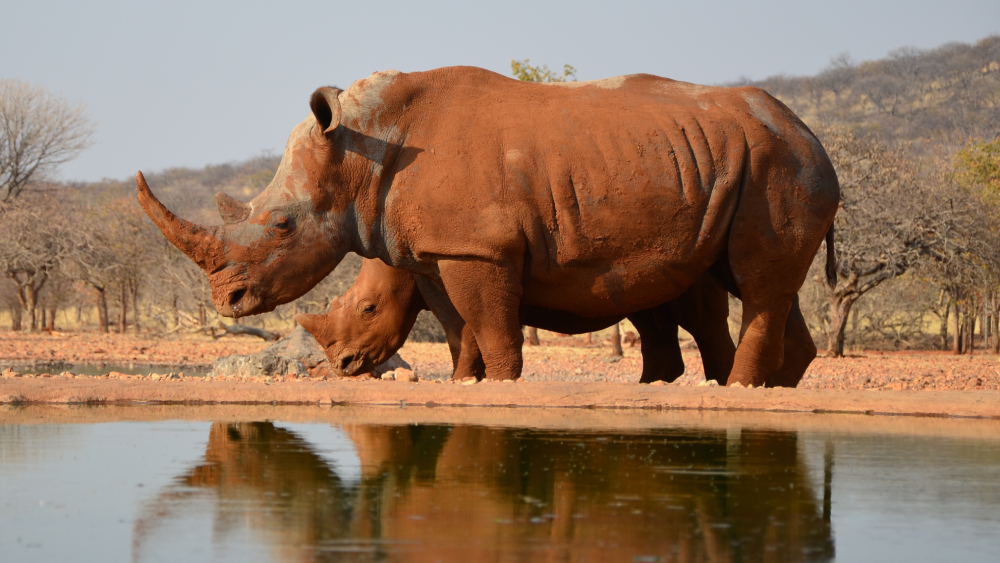
One of Alpha Aid’s latest initiatives has been the training of police and local authorities in Namibia to combat poaching.
Anti-poaching teams in Africa can run the gamut from government interventions of widely varying effectiveness to militarized private contractors protecting private game reserves. The Alpha Aid team is helping train police officers in the area south of the Namibian capital, Windhoek. Skills everything from how to conduct a roadblock to surveillance to how to approach a suspect safely.
“We work together with police officers. In the last year and a half, we decreased the poaching across hundreds of farms by 90%. And 90% means that something has changed in what they’re doing.”
Alpha Aid has also launched a self-sustainable farm project in Namibia. The site aims to be a hub for developing sustainable farming techniques tailored to Namibia’s environment featuring hands-on skills training and community workshops.
Binek attributes Alpha Aid’s success to empowering local teams with basic skills and basic equipment and the knowledge to apply them to solve their own problems. For Namibia’s antipoaching efforts that has meant everything from education on drone operation and the logistics of setting up a roadblock to acquiring body armor and learning how to approach a car that may be filled with well-armed syndicate poachers working with organized crime.
“We lived with those people. We went to farmers associations and talked to a hundred farmers. You need to put your hand in the fire and say to them ‘I’m here with you.’ We realized that certain things can be done very fast and very easily. That becomes a multiplier where they can show another guy and they can do it themselves.”
Production skills are life skills
“I don’t want to be in Africa for the next 100 years. I don’t belong there. And I don’t want to impose the conditions of ‘you are my client for the rest of your life’ and post everything on Instagram.”
Binek’s story is a reminder of the depth of skill and experience that runs across the film and TV industry. Problem solving by highly skilled specialist is at the heart of any good production. Our industry has a lot to give the world after the wrap.
“What I’ve been doing for the last year and half is work for a living then spend that time and money to go somewhere else and do something for Alpha Aid,” says Binek. “It gives me such balance. I’m rejuvenating myself because I’m going to countries where help is needed and they appreciate it. It’s a complete contrast to the corporate executive protection field, where you have to have your cappuccino at 9:30 am.”

Related stories:
 The June heatwave showed productions are unprepared for the temperature rises ahead
 ¡AU! Journal – Spring 2026
 With an expansionist neighbor, Baltic broadcasters are taking disaster preparedness seriously
 Film (and VHS and Hi8 and MiniDV) is forever at the BSC Expo
 Cybersecurity expert Shaun Reardon will join Content Defense Summit to address production safety
 A safe hand-off: Best practice for securing production & post files
