
This past weekend, FCC chairman Brendan Carr threatened to revoke the licenses of broadcasters who air what he called “fake news” around the US-Israeli attack on Iran. This is only the latest in a campaign of intimidation of US media companies by the administration.
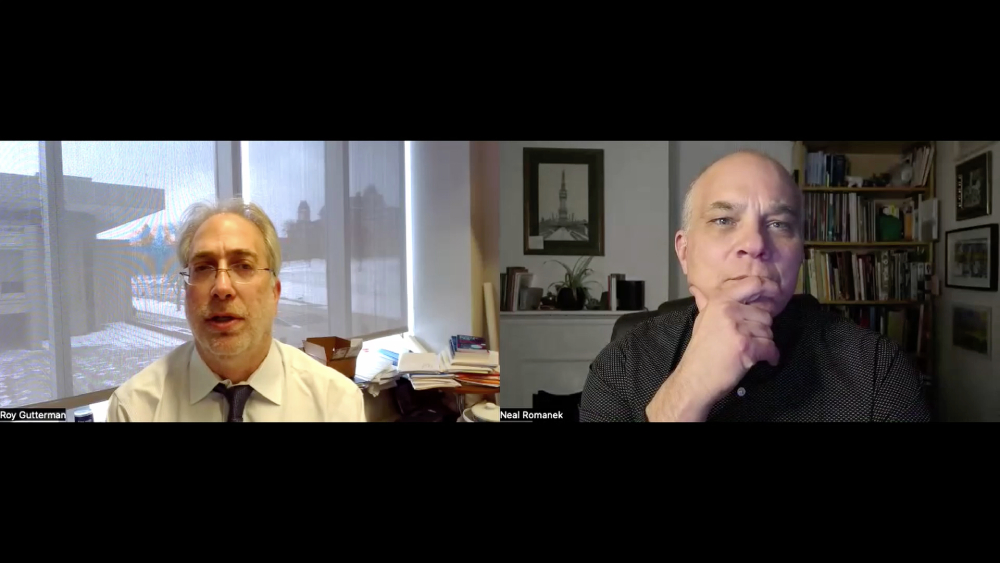
What can the FCC realistically do to US broadcasters? What is the future of press freedom in the US? ¡AU!’s Neal Romanek talks with Roy Gutterman, director of the Tully Center for Free Speech at Syracuse University’s Newhouse School of Public Communications.
TRANSCRIPT (with minor edits for clarity):
Neal Romanek: Hello, it’s Neal Romanek from ¡AU!, and I’m really excited to be talking to Roy Gutterman today from the Tully Center for Free Speech at Syracuse University?
Neal Romanek: Thanks so much for coming on. One of the things that we like to talk about at ¡AU! – and I think it’s an important topic, because so many things sit on top of it – is the information space and ensuring that it is as uncorrupted, as we can make it and as useful to people as we can make it.
There are a few issues – it seems like there’s a lot of issues coming up all the time, but especially this past week – about some interference with American broadcasters about news and the Iraq War. Or the Iran War! Freudian slip there.
Roy Gutterman: Pick your war.
Neal Romanek: There’s so many to keep track of. And we can talk about that, but Roy, maybe start off telling us about who you are, and also what the Tully Center is.
Roy Gutterman: Sure. I teach First Amendment law, free speech, free press law here at Syracuse University at the Newhouse School. And I’m a former newspaper reporter and a former lawyer. So I’m working my way down the respectable professions.
Now I’m a professor, and a lot of what I do is based on everything I’ve done across two careers – which seems like a lifetime ago. I’ve been teaching at Syracuse for 21 years, and I’ve been the director of the Tully Center for Free Speech since 2010.
The Free Speech Center is aimed at educating the public on free speech and free press issues. One of the biggest things we do every year is recognize a journalist who’s faced significant turmoil in the previous year. Three weeks ago, we recognized a reporter from The Marion County Record here in the United States, in Kansas, a newspaper that was the subject of an illegal search warrant. So much so, that the stress ended up contributing to the death of the publisher – the editor’s mother, who was 98 – and put this little aggressive weekly newspaper in the crosshairs of local law enforcement and made it an international symbol.
That’s one of the bigger things we do. We have some advocacy through writing and speaking and educating our public and our students on these issues.
Neal Romanek: Kick us off with the free speech issue of the past couple days, or 48 hours. Brendan Carr, the head of the FCC, has been threatening, or seeming to threaten to pull licenses from broadcasters who don’t toe the government line about reporting on the Iran War, it would seem. That’s my assessment of it. Can you maybe tell us a bit about what he is doing and what he has said?
Roy Gutterman: Most of what he said is rhetoric at this point. We had a little spat of this over the summer as well, where he threatened that the FCC would act on license renewals and become an impediment, or try to take them away because they the administration doesn’t like the tenor of the news. So far, there’s been no action, and it just gets a lot of headlines and it gets people rankled up and it’s scary.
We’ve never had the Federal Communications Commission acting so aggressively on news content, on news content that an administration doesn’t agree with the FCC. First of all, it’s an independent agency or an independent commission, so it shouldn’t be necessarily carrying the President’s water anyway. But it’s also beholden to the Administrative Law process and our First Amendment.
Even if – and it would be a big “even if” – the FCC wanted to act in a negative manner or in an aggressive manner to punish critics, there’s a long, detailed process that would require a lot of paperwork and public hearings and public notice. That would all be subject to judicial review as well, so it would be a long shot. But it’s still a threat. And a threat is a threat. When it’s coming from the upper echelons of government, it’s intimidating, imposing, and chilling.
Neal Romanek: Is it also part of a package of threats? Because, backing up a bit, you’ve got CBS, Disney, you’ve got these broadcasters or media companies that were bullied a bit by the administration early on and decided to just pay the fine. “We’ll pay the parking ticket to not be harassed”, even though, some of these things, if they had gone to court, it wouldn’t have been a problem. But it was like, “We’ll just pay what the President is asking, and then that will get the heat off us”.
Roy Gutterman: Yeah, we’re in a media and a business climate right now that it’s kind of scary because we’ve got business entities making media decisions and content decisions aimed at facilitating or smoothing over bigger and bigger business deals. When you have a news outlet beholden to some corporate entity that wants to get bigger, to make more money, then that’s going to compromise some of the editorial decisions, as we’ve seen.
We go back to over the summer with Jimmy Kimmel, the late night comedian, who, in all honesty, was the least political – maybe the second least political, but not a very political comedian – and we saw him get benched because somebody in the administration didn’t like it. A joke that wasn’t even really aimed at the entities that they thought it was aimed at. It was really an offhand comment that that got him benched by his bosses.
Again, it wasn’t the government that was benching him, but government entities approached some of the people involved at the upper echelons of Disney, and they’re involved in business deals, and he got benched. There was big public backlash
Down the road at CBS, we saw Stephen Colbert, the host of the Late Show at CBS, who was the most political of the three late night TV hosts. He was dismissed, ostensibly because the people that own his company are in merger discussions, and they don’t want the government to interfere in that.
The government can very easily invoke antitrust laws on some of these giant mergers and at least become a headache for the business entities. But CBS preemptively avoided that. We don’t know if there were efforts made behind the scenes by people in the government to get Colbert removed, but Colbert is going to be off the air in a few months because of that.
Neal Romanek: I remember because it happened last year, and I remember thinking, “Well, it’s going to be a year (from now)”, and of course, that’s (been) the year.
At The Center, do you look at – from a systemic point of view – how these things happen, because there’s so much stuff that kind of comes at you. You’re like, oh, there’s that, and there’s that, but it would seem like, if you’re shutting down free speech, or you’re attacking free speech, or when free speech is in danger, that there may be things that you can look for, or patterns, or things that happen.
Roy Gutterman: If I was looking for a pattern, I would probably try to look to see what the bad news was that week that prompts this sort of outburst. The movie Wag the Dog is a pop cultural reference at this point, from the 90s. But I think if somebody was going to track whatever the bad news was that week to some of these prominent comments about reigning in the press or revoking licenses, or whatever other business the FCC wants to try to do, it’s linked to some pretty bad news, whether it’s the economy or a war that’s not going to be very popular or just low ratings at the presidential level.
Whatever the bad news is that week – the Epstein files, you name it – this could be a nice distraction. Now we’re all wringing our hands for a week over threats by the FCC that really can’t come through – but still, they’re threats.
Neal Romanek: It’s like – looking internationally, and I’m in the UK – Donald Trump threatening to sue the BBC, which is probably kind of crackers. I don’t think he really could sue the BBC. Or maybe he could. I guess you could sue anybody. But over here, people felt the length of the leash. In the news, you could feel that people are like, “Oh, should we be careful about what we say about the American President?”
Are you looking internationally about how these things work in other countries? Because obviously you think of cracking down on free speech as traditionally a thing that we in English speaking countries (think) happens “over there”. That happens in Russia, it happens in other countries. It doesn’t happen that much here.
Roy Gutterman: There’s a playbook out there for some of the stuff that we’re seeing, for the first time in centuries, here in the US. The threats to the media, whether it’s private litigation – the overuse of private litigation – and with defamation, the abuse of defamation law, and proxies filing these types of lawsuits. Again, the efforts to use all branches of government to reign in or punish critics or the press itself. There’s a playbook for this. I’m not going to start naming countries. I don’t want to get banned from countries I’m probably not going to go to in the near future. But we’ve seen this all over the world, and it’s coming to us now and we’re dealing with it.
We’ve never had a president who’s been so aggressive against the media. We’ve had Nixon, but Nixon at least, believe it or not, played by some rules, and Nixon at least, was countered by opposition in Congress. We don’t have that right now. We’re really dealing with things that we haven’t seen in anybody’s recent memory.
There is a playbook for this: use the law, abuse the law, use levers of government to shift personnel into these private media entities, which we’ve seen – and we’re coming to terms with this. When the Secretary of Defense starts lauding another giant, mega merger and boasting that he can’t wait for CNN to be taken over, that’s a pretty scary thing. You can disagree with editorial content – that goes with the territory – but to openly call for new bosses, or a new editorial swing, that’s uncharted territory. And that goes on top of other things we’ve seen – limiting the press pool, with the White House, the Pentagon. It’s a multi faceted approach. I don’t know if they’re sitting in a back room saying “We’re going to do this, this and this”, but it certainly has that effect.
Neal Romanek: I’m also thinking about social media, and the collapse of the truth space – what is true – and that cheapening of news to begin with. It starts with Trump’s first week in office – the first time around – he was saying, “fake news, fake news, fake news“. Just getting that idea into the public consciousness: “It’s fake news. You can’t trust anything”. I feel like we see that at CBS now and everywhere – that attempt to take the teeth out of news, or take what was factuality in news and turn it into something else.
Roy Gutterman: I hate to make everything Trump, Trump, Trump. But he was pretty clever during his first campaign when he started using the term “fake news”, this Orwellian term. It discredits all sorts of news. It’s a term that we’ve heard before, but discrediting news you don’t like, coupled with the fragmentation and the politicization of news, or what people think is news.
Here (in the US) we’ve got three 24-hour news channels. We’ve got Fox, and people know Fox’s political affiliation. We’ve got MSNBC. Everybody knows MSNBC’s political affiliation. Then somewhere in the middle, we’ve got CNN. Part of the problem is people will spend time watching either of the polarizing TV channels and think they’re getting news when they’re really getting editorial content. That’s been a troubling thing for the last 30 or so years.
Neal Romanek: So are you working on a plan to turn it all around at the Center?
Roy Gutterman: I do a lot. I do a lot of writing, a lot of public speaking on these issues. But like anything, I’m most of the time talking to people who would probably agree with me.
The beauty of our First Amendment and our marketplace of ideas is that you have a right to disagree, and you do have a right to seek the content that that you want to seek. But more and more of that content is being skewed by one political side as opposed to the other.
We see businesses getting out of the news business to make more money doing other things – selling movies or producing movies, but they’re still beholden to the news content and their news operations. You’ve got these big businesses that are reliant on some level of government support, meaning avoiding antitrust regulation or any other government regulation. The news side of this, which ends up costing these businesses a lot of money to make to begin with, then becomes expendable or something that they can use as a bargaining chip to get what they want from an administration that gives out gifts and accolades to the people who agree with them.
Neal Romanek: Looking at social media – and I guess this gets down to what is free speech, because certainly Elon Musk, and all the tech oligarchs talk about free speech, meaning “I should be able to say and do what I want. I’m a billionaire, I should be able to say what I want and do whatever I want on this platform.” And that’s free speech. So first of all, what is free speech? And how do you guarantee that the right people, that everybody gets an equal shot at free speech?
Roy Gutterman: Free speech, for a definition, I like the European definition of freedom of conscience, freedom to think and express yourself in different ways.
Speech is more than just verbal and vocal. It can be symbolic. It can be written. It can be just about anything. Like hair color. If you dye your hair green, that could be a free speech issue. Or you want to put a tattoo on your face, that’s a free speech issue. It can means a lot of different things to a lot of different people, but I really think it’s freedom of conscience and how you think about things and how you express yourself about things, especially matters of public interest.
That’s trying to get a thumbnail on a pretty broad issue, but as far as putting a price tag on it, there’s a famous slogan: “free speech isn’t free”, and that can mean a lot of different things as well. It’s no secret that if you have the means, the financial means, you have a bigger voice. Our Supreme Court pretty much endorsed that more than tebn years ago in the controversial Citizens United case.
Now everybody’s got a place at the table, which is nice, but if you’ve got the resources to buy a billion dollar social media platform, then you will have a bigger voice than some regular guy in the middle of nowhere.
Neal Romanek: But the job of government, when it works, is to have guardrails in place so that the billionaires don’t have as much control over the media and regular people. What are the things you do to create that free speech?
Roy Gutterman: Part of the beauty of social media is you can have access, you can have a place at the table, even if you’re a solitary person in the middle of nowhere. Going viral can happen. You can go viral (even) if you don’t have millions of followers, but it’s harder.
The other concern is that these billionaires who own social media platforms do have the ability to silence people. Elon Musk was a free speech absolutist the day before he got Twitter, and then when he got it, miraculously, some critics were deplatformed. That’s part of the concern, but it’s nothing new. A hundred years ago, 150 years ago, if the publisher of your local newspaper didn’t like your your politics, he didn’t have to run your letter to the editor, and you had no recourse. But, that was a long time ago, and it was a smaller market, and the world was a lot smaller 150 years ago.
There’s no panacea, there’s no silver bullet, there’s no magic key, but if I was to put it into a pithy little statement, I’d say that the government’s role in free speech is to protect the market for free speech, to allow people to have the platform. The government’s done that through the years, going back to what we had a hundred years ago. Or 50, 60, years ago, we had what was known as newspaper preservation laws that were aimed at preserving newspapers by allowing them to merge and allowing them to use some resources like printing plants, as long as there were different newspapers.
Broadcast regulation has rules on public interest. If you have a license, you have to use it responsibly, meaning you might have to have some children’s programming, diversity programming, no profanity on the airwaves during normal hours, and those are reasonable restraints.
But the internet – it’s hands off. And we’ve got federal law that keeps it hands off with Section 230, which for its first 20 years was a relatively obscure, or rarely talked about, section of federal law that facilitated the growth of the internet that now both parties really don’t like. Conservatives don’t like it because they think it’s allowed social media platforms to de-platform conservative viewpoints. People on the left don’t like it because they think it facilitates hate speech and violent speech and incitement and other types of illicit activity.
At least both sides agree that they don’t like something. Nobody knows how to fix it.
Neal Romanek: You mentioned at the start that ytou gave your award this year to somebody working in local news. What are the free speech issues or the place of local news in that? We talk about news on kind of a national level – CNN, MSNBC – but what about – and there are fewer and fewer of them – how does local news fit into that free speech ecosystem?
Roy Gutterman: Local news is where there should be growth. That’s what people need the most. There’s always going to be nice, healthy level of coverage at the national level – international, at least in the US, seems to be waning.
We saw the news at The Washington Post a couple of weeks ago, where they were getting rid of most of their international staff. Again, that seems to be an American thing where Americans don’t seem to have a taste for international coverage anyway. I’m not apologizing for that. I’m just speaking of the world view of many citizens here.
But when it comes down to it, just like politics, news is local. We’ve seen cutbacks in local news all over the US and In the last ten, twenty years, even at the local weekly newspaper level. And that’s where it counts the most, because that’s who’s going to hold local government officials most accountable. There’s always going to be national press to hold the President and Congress and Supreme Court under under scrutiny, but when it comes down to it, most of our lives will not intersect with federal government. Most of our lives really do deal with local issues – snow plowing or potholes or property taxes or social services, and that’s all local stuff. That’s all stuff that we really need covered.
The example that we’ve seen, that we saw out of Kansas a couple of years ago, is a really stark example of how you abuse the law to punish aggressive local journalists.
Neal Romanek: And what happened in that case?
Roy Gutterman: In the aftermath, the search warrants were deemed to be extremely illegal and was an abuse of government power. The newspaper won a $1 million settlement, and the reporters won a settlement. The process and the administration of the law ultimately prevailed in that case.
But the mission was accomplished by the law enforcement officials. It was harassment, it was menacing, it was imposing. It was devastating to the family. And anybody who’s ever been on the receiving end of a search warrant or a subpoena to testify, even if it’s specious, just to fight it will be a headache. So the mission was accomplished.
Neal Romanek: What is going to happen over the next year or two years? We’ve got in the US a couple more years of this. I don’t know, if you look internationally. But how do you anticipate things going?
Roy Gutterman: For decades, the United States was a beacon on these issues of free speech and free expression and free press and a government hands off approach to dealing with content and critics. We were a role model for countries around the world, and that beacon is dimming. We still have process and we still have rule of law, but we’re losing some of our luster on that.
When other people around the world see this here, I think it could embolden others and empower others. Reporters and journalists face significant difficulties all over the world, whether it’s war zones or in hostile parts of the world, and the US was always there to point a judgmental finger. In some ways we’ve lost and that ability, and that puts reporters everywhere at risk.
Neal Romanek: Is there any other place you’d look that’s still upholding that? Or somebody to look to?
Roy Gutterman: Western Europe is doing a pretty good job. Central and Western Europe. The world is a complicated place these days, and hopefully things will will change. People need news. People need information that’s not censored or dictated by government officials and that transcends party agendas. Hopefully people will recognize that.
Neal Romanek: Absolutely. It’s something that can turn around and bite you pretty quickly. You think it’s going to be working in your favor, but it’s like you’re digging out the whole system from underneath you. I think these institutions have been taken for granted that they’re just there and that they’re going to keep working for people.
Thank you so much for taking time out to talk. It would be great to learn more about what the center is doing. Is there anything coming up that you’re working on that we should know about?
Roy Gutterman: No. I’m just trying to keep my head above the water. I’m sometimes afraid to look at the news, because I never know what kind of crazy things are coming down the pike that day. But it keeps it exciting.
Neal Romanek: Yeah, very exciting. A little too exciting. Thanks so much. Roy. Great to talk to you.
Roy Gutterman: My pleasure. Anytime.
Related stories:
 News networks vacate Pentagon after press credentials deadline passes
 Hook up with fellow pirate hunters using our NAB Show content security guide
 Danish Parliament to vote on law for deepfake defense
 Video: “A woman’s place is in the audience and other lies” – from ¡AU!’s Emergency DEI Summit
 Video: C2PA is not a protocol droid – it’s a plan for restoring freedom to the content galaxy
 Video: “How to rise when you’re below the line” – from ¡AU!’s Emergency DEI Summit
