
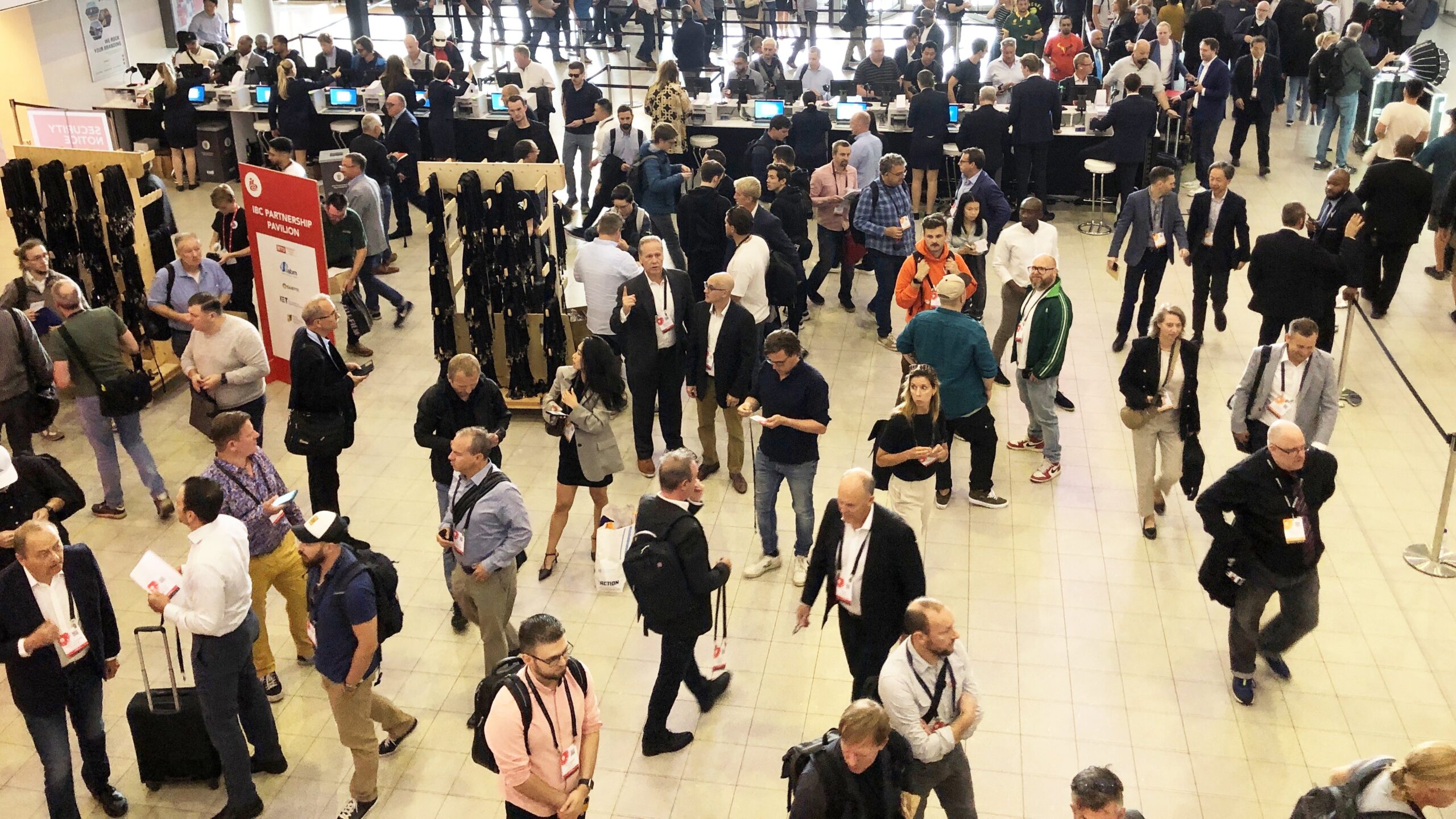
This past weekend was the second IBC Show for ¡AU!, but certainly not the second for me. I’m well into double digits now.
IBC is one of the world’s top gatherings of media tech technologists. From your favorite VOD platform to your local news station, it’s all being powered by kit and infrastructure on display at this annual Amsterdam convention.
So what was the big broadcast news of the weekend?
The US President called for a united Ireland.
Yep, that was the big news for the broadcast industry over the weekend. What does this have to do with the broadcast technology industry? Skip to the end if you can’t stand the suspense.
But first, here are some of our top observations from IBC2026…
No more money
“That revenue is not coming back”. That’s what an executive at a cloud tech company told me. He meant that the income stream broadcasters have been used which has been rapidly falling off over the past few years, is not going to rebound. Broadcasters need to get used to the idea that they are not going to be able to make the content they have in the past or afford the infrastructure and tech that they have been used to.
As a cloud-based tools provider, did he have an interest in seeing tradtional broadcast models fail? Maybe. But this grim assessment was repeated by a number of vendors we talked to.
Still, there were plenty of vendors offering high-end gear for high-end production by high-end broadcasters. There are still companies counting on money being available.
The general trend in the global economy has been accelerating income inequality – a handful of people suck up the wealth, the remainder wallow in an ongoing cost-of-living gray zone. This process is also happening across industry. We have seen a flurry of high-profile mergers where media companies, sometimes backed by Big Tech, are acquiring competitors – see Comcast’s NBC Universal adding ITV to its roster, or Oracle-backed Paramount Skydance’s determination to get Warner Bros.
When the dust settles, there will be fewer players, but they will theoretically have more money at their disposal. Is it these few last-broadcasters-standing that the high end vendors hope to keep servicing? Operating outside the world of M&A’s are state-backed broadcasters, who can withstand some of this acquisition fever, but they are still being hit by the same declining revenues – in their case through government cuts, rather than corporate streamlining.
The big broadcast tech suppliers understand these challenges complexity, and they are worried, but they’re not standing still. We saw multiple products aimed at making broadcast lighter, cheaper, and more responsive. Literally days before the show, broadcast tech mainstay Grass Valley rolled out an all-in-one solution for live production, which would allow small teams to spin up and produce quality live broadcasts without needing several million dollars worth of kit on standby. This joined already existing products from multiple vendors which promised that fewere people could produce more live shows with greater flexibility.
We’ve seen this sort of tech for a while – easy switching, easy streaming, easy monitoring, usually based in the cloud, but what felt new at this IBC was that vendors were making these tools available for high-end output – maybe not World Cup “high-end”, but high-end enough for most TV audiences and certainly overkill for tier three or niche broadcasters.
This felt like the IBC where, after idling along for a decade, the industry finally got very serious about workflows that can be deployed quickly, produce solid content, and aren’t over-reliant on pre-existing infrastructure to do the job.
The driver is, of course, the economics. Broadcasters urgently need a way to do their work under conditions where their teams have been decimated and their studio facilities are being sold to make way for luxury flats. We saw a lot of tech vendors prioritizing products that could help them do that.
Sane & sensible AI
There had been great anticipation about the presence of AI-superpowered tools at the show. The assumption – or anxiety – was that it would be an AI tsunami with every company pushing forward all singing, all dancing AI-driven products that would change the way you do media for all time. Yep, this was the IBC where the robots would take over.
It turns out the implementations of AI at the show were – for the most part – sensible and sane. There were a good number of cases of companies glueing a chatbot onto whatever tools were already offering, but this is a risky move for an industry that needs to have things work well in a critical live broadcast environment.
While total attendance at the show was down this year, the people who showed up were the serious broadcasters and technologists unlikely to be taken in by some half-assed AI vapor ware. Knowing this, most vendors with AI tools emphasized utility and practicality. Metadata enrichment and search were the biggest implementation – enabling users to use natural language to query aspects of their workflow. This was especially useful where it allowed oversight of large scale parameters, like the vicissitudes of networks or CDNs, and audience engagement. AI-enabled automation in workflows was another big implementation, where AI’s could do best-guess editing, encoding, distribution and the like.
In short, when AI had been introduced in a piece of kit, it was more or less where you would expect it to be. Slow and steady progress. There were few big AI surprises or monumental breakthroughs – and that in itself was oddly reassuring.
The pitch is that AI will create savings through efficiencies and being able to do things that people can’t do. But with AI replacing are low-paying jobs – things you would ask an assistant or trainee to do – how much money are you really saving? Broadcasters are still demanding proof before taking the leap.
Appropriate as we start into the Halloween season, LLM-driven simulacrum “Tilly Norwood” was interviewed on stage for the IBC conference series. This recalled the IBC appearance of the ghoulish automaton “Sophia”, by Hanson Robotics, in 2017. IBC seems to like a cheerful female robot. But on the whole, AI-generated content was thin on the ground. Even Hall 14, the exhibition space for most of the AI-first tech, shined the most when Gen AI was used for things like automated translation or localization, rather than content creation.
Grab them by the data center
So back to the US president and his visit to Ireland and his call for Northern Ireland to leave the UK.
He said: “I don’t want to cause any problems, but I will tell you, I’d love to see it unified…The way I look at it, it’s going to happen eventually. It may as well happen now.
“The UK will have something to say about it, obviously. But I think it would be a great thing. I mean, how can it be bad?”
Certainly the President must be aware of a certain amount of historical fractiousness when it come to questions of borders and territory in Irish/British relations. But, sure, how can it be bad?
A principle feature of US foreign policy over the past two years has been the violation of sovereignty – in human rights, international law, borders. There is an aggressive ongoing strategy of trying to shake loose established boundaries and norms. It operates as a steady feed of innuendo and rhetoric which can then escalate to economic or political attacks, and then to military intervention. Critics often complain that US foreign strategy is chaotic, but it’s actually quite consistent.
The modern media sector was built on the assumption of a fairly iron-clad stability across the western world with the US as an essential partner, from tech to content to business. Complete dependency on US companies wasn’t really seen as a problem because, well, “how can it be bad?”
But what we saw at IBC this year was a broadcast industry – primarily European – well aware of the need to decouple from the US.
At IBC a year ago, if you made a joke about someone in Washington making a call, then finding out your journalists had been locked out of their Google accounts – and we did – it was received with a knowing laugh. This year, the response was: “Yes, absolutely. That’s a concern we have.” European companies – particularly state broadcasters and organizations that to guarantee security – are putting sovereignty high on their tech priority list.
Dublin is home to one of the most important AWS data centers in Europe. If you’re using a European company using AWS Media Services, your data has passed through Ireland.
Now just because someone is walking around your house saying provocative things, doesn’t mean they’re going to do you harm. When they say “Nice borders. Would be a shame if something happened to them”, they might be expressing genuine concern for your well-being. But it looks like European media companies are becoming less willing to take that chance. It’s not that they are anticipating harm, but they are anticipating uncertainty.
We heard that cloud-only mania has peaked and that hybrid solutions, where some control can be maintained over your own facility are becoming the goal. Along with that, is a pivote to more integration with local cloud partners, outside of the big US providers. Of course, at present there is no competitor to the likes of AWS for media workflows. But for less complex media tasks, the hyperscalers are no longer the automatic go to.
The need for sovereignty is being driven by pressure from the East as well, with drone incursions and Russia-backed provocations becoming more frequent. It’s my bet that – assuming Europe wants to stay Europe – this drive for tech sovereignty and flexibility will accelerate over the next year. Broadcaster budgets are shrinking, but defense budgets are growing. Creating sovereign cloud and digital infrastructure could be seen as matters of national defense. If I was a military planner, I’d be pouring money into regional digital infrastructure and digital security (and drones). All this could have a knock on effect for broadcast tech.
Change or…There is no “or”, just change
The broadcast industry is globally in a state of change or die. Or maybe “die” is already built in and inevitable, so the only choice is to leap into the waves of change and sail to something better. YouTube is happy to become the global broadcast platform of choice – but real prosperity for broadcasters will come from independence of other platforms, not surrender to them.
There was a lot more at the show – good work presented on sustainability and streaming, plus more women participating in the show than ever, and the launching of our Breaking The Silence report, which we’ll be publishing with the Media Talent Manifesto in November. But we can get into all those another time.
Now these conclusions we’ve drawn are all, you may have noticed, in areas of special interest to ¡AU!. It’s easy to become convinced that your own areas of special interest are the most important, because, after all, those are the kinds of things you are inclined to notice.
Let me know what your IBC takeaways were and what you inferred from the conversations you had. The most important insight is usually one that someone else has to point out to you, something you missed because you were so focused on your special thing. Let us know what we should be following up on, and what we should be covering between now and next year’s IBC Show.
Related stories:
 With an expansionist neighbor, Baltic broadcasters are taking disaster preparedness seriously
 Hook up with fellow pirate hunters using our NAB Show content security guide
 Europe is taking on the sovereign CDN challenge
 Video: We talk to the Tully Center for Free Speech about the FCC’s threats against US news networks
 AWS claws back some climate cred with updated Scope 3 tracking
 Content by no one for no one: Surviving the Gen AI bubble
