
The long queue to get into the BSC (British Society of Cinematographers) Expo is always a surprise. It shouldn’t be. Every year you round that last corner in Battersea Park eager to see the latest camera gear and you’re pulled up short by a hundred people standing in the rain all asking “Is this the right queue?”, hoping there has been some mistake and there is another, much shorter, queue that they belong in.
One reason the Expo always has that long queue – nthere may be others we don’t know about – is bags are not allowed inside (this is another thing I annually forget) and must be checked before entry. How come? Because BSC is the top trade event in the UK for cinematographers. It’s wall to wall with items that are valuable and bag-sized. A thief could walk out with a £20,000 lens in their pocket with no one the wiser.
The show is aimed at the camera department – cinematographers, operators, grips. Exhibitors and attendees work at the coal face of production and at the show you’re likely to get a more unvarnished take on where film and TV production is heading than you would from people farther down the content supply chain.

This year on the floor, people expressed anxiety about instability and the rate of change (“Then you should read ¡AU!” I replied cheerfully, before being clocked in the temple with a 800Wh block battery). Will there be more production-paralyzing writers strikes this year, for instance, as the next agreement with studios is negotiated? Staff at the Writers Guild walked out this week, citing bad faith negotiation by the Guild’s management, which suggests the Guild won’t be going into the negotiations in the most serene frame of mind. What happens in the US, has global fallout, especially for the content industry. Those of us living in the rest of the world are learning just how bad the whiplash can be when you can’t let go of the American tiger’s tail.
But instability is also change. New things. Or sometimes old things re-emerging as new things. A surprising – I would say even delightful – twist at this year’s BSC was the appearance of old school tech on stands.
Film is developing
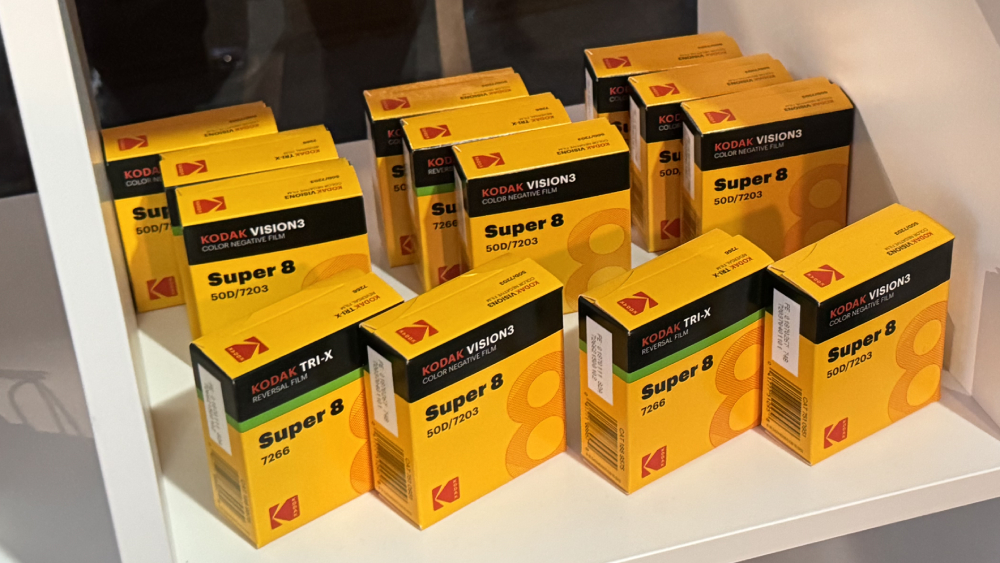
Kodak has been a regular presence at the BSC Expo, lording itself over the industry with its virtual monopoly on physical film production. Its always reassuring to see its big yellow stand, but this year, film popped up in places outside the ivory yellow Kodak tower.
On8mil made its BSC exhibitor debut this year. The booth was swamped with young filmmakers investigating this fascinating new technology in which light falls onto a chemically treated strip of celluloid to produce an image. Based in London, On8mil has billed itself as “London’s home of analog motion picture film processing and scanning”. It has been a specialist in Super 8 film and equipment for years, providing film processing and scanning and refurbishment and sales of gear.

The company started as “a one-man Super 8 scanning operation in a garden shed” and is now a service provider for productions and directors using small format film. The lab also does upgrades and innovation around vintage film equipment. On display at the show was an arsenal of vintage film equipment, from Elmo film viewers to Soviet era wind-up 16mm cameras that have been retrofitted with mounts for modern lenses, to that same Super 8 camera your dad had.
One of the issues with Super 8 film is that it comes almost entirely from Kodak. It also comes exclusively in the cartridge format Kodak developed – as it has for 50+ years. The cartridge was revolutionary, making it possible for anyone in any circumsances to load a film camera. Especially important with 8mm film which would be fiddly even for experienced operators. The problem is that when cartridges were sent off to the lab and the film inside developed, the cartridges were thrown in the bin. Every single spool of Super 8 film ever shot been accompanied by a chunk of landfill plastic that weighs substantially more than the film itself.
Enter On8mil’s project to create a reusable, universal Super 8 film cartridge.
Spearheaded by On8mil’s Managing Director Edmund Ward, the metal cartridge would be issued fully loaded with stock (which wouldn’t necessarily have to be manufactured by Kodak), then after shooting returned to the lab for developing and scanning, with the cartridge immediately available for reuse. Another advantage of the reloadable Super 8 cartridge is that cartridges don’t need to be mass produced, loaded with film, and kept in stock. The lab supplies only what customers need.

Ward showed ¡AU! the prototype, patent pending, which features an internal brass spool. The cartridge doesn’t have a 100% success rate for all varieties of Super 8 cameras and is still a ways out from a mass-produced product. It’s a sustainability win, of course, but it’s also a big step toward normalizing film use for more creators.
The right to analog
Leveraging legacy tools wasn’t confined to the world of film chemistry. Vintage video gear also made an appearance. Providing rental and servicing, one company was offering refurbished video equipment from VHS to Hi8 to MiniDV. These are usually used for speciality b-roll on music videos and the like, but the fact that the cameras are available in bulk – not just some camera pulled down from the attic – with a variety of formats to choose from, suggests there is an opportunity here for more than just a novelty video effect.

Other companies supported this principle of long-term use of technology and a “right to repair”. The 3D People, making their BSC debut, are a 3D printing service that does high quality on-demand work for a variety of industries, including a lot of spillover fabrication for automotive companies.
The ability to quickly prototype and manufacture gear, accessories, augmentations in small or single batches can give gear another life – even a better life – which only ten years would have ended up in a landfill or at best would have required overhaul by the manufacturer at great expensehat
tBeing able to repair, augment, improve gear according to your own specs is still very much in the blood of film production. Creators like to have a relationship with their tools. They like to make the tools their own. While digital cinematography has brought impeccable quality and standards to the industry, there is very little in the world of digital image creation that allows an artist to make it self evident that they were there capturing a once in a universe moment with their tool of choice done in a way that no one else could have in that particular instant. Digital makes a recording, but it doesn’t make a record.
The silver scheme
One of our favorite companies, From The Silver Screen, shared a booth top UK film laboratory Cinelab. Cinelab’s proud showcasing of its growing film-based work year after year is heartening for film lovers, but From The Silver Screen captures that extra bit of magic contained within the chemistry and physics of shooting on film.
The company sells high end silver jewelry created from silver reclaimed from the development process of movies shot on film. Normally the film would be recycled back into the silver supply chain, but founder Natalie Daniels initially working with Cinelab saw the value, and the romance, of literally owning and wearing a piece of a film.
From The Silver Screen now has deals with productions and companies, including Focus Features, to create certified to be part of the development process of specific films. There most recent creation is a honeybee made from silver from the stock of Yorgos Lanthimos’ Bugonia. Others include Wes Anderson-themed pieces made from the processing of The Phoenician Scheme, which were sold at the London Design Museum for their “Wes Anderson: The Archives” exhibition.
Is there going to be a reactionary stampede back to a non-digital production past. No way. But there was palpable excitement about the old tech from those engaging with it at the show, film students thrilled about film as if it was a cutting edge technology. Young people today don’t see digital as something new and improved – it’s pedestrian and every day and status quo. Creativity isn’t just about new ideas, it’s about new tools for artists to experiment with, even if they’re old.
Related stories:
 Sony ups its content authentication offerings
 Be You Festival convenes diverse creatives to plot a new future for UK media
 ¡AU! partners with The New Black Film Collective to make diversity great again
 AWS claws back some climate cred with updated Scope 3 tracking
 Emergency summit on the collapse of DEI in the entertainment industry, March 24
 AI news summaries are still terrible – and hurt the reputations of news brands
